What Actually Calms Your Nervous System in the Moment (And What Doesn't)
A Stanford study put four techniques head-to-head for fast stress relief, including mindfulness meditation. One breathing pattern won clearly. Here's the real research behind it, plus the honest evidence for grounding, reframing, and release.
By Coach Nadira · Stress & Anxiety · 8 min read

Photo by Jakob Andersson via Pexels
When stress hits, most advice is vague: "just breathe," "try to relax," "think positive." None of that tells you what to actually do in the next ten seconds. So let's get specific. A rigorous Stanford study directly compared several in-the-moment techniques, and the results were clearer — and a little surprising — than you'd expect.
Breathe: the best-studied technique, by far
In a 2023 study out of Stanford, 111 participants practiced one of four techniques for five minutes a day, for one month: cyclic sighing (also called the "physiological sigh" — a double inhale through the nose, then a long, slow exhale through the mouth), box breathing (equal-length inhale and exhale), a breathing pattern that emphasized inhalation, or mindfulness meditation as the control.
- All three controlled-breathing groups beat meditation for improving daily mood and lowering physiological stress arousal.
- Cyclic sighing won outright. It produced the largest boost in positive mood (a 1.91-point increase versus 1.22 for meditation) and measurably lowered participants' resting breathing rate throughout the day — not just during the exercise itself.
- The effect got stronger with practice across the four weeks, rather than fading.
The researchers' explanation: a long, slow exhale is what activates your parasympathetic nervous system — your body's built-in "calm down" switch — more directly than inhaling or holding your breath does.
The honest bottom line
This doesn't mean meditation doesn't work — it's well studied for other outcomes over longer timeframes. It means that if what you need is fast, in-the-moment relief, a specific breathing pattern currently has the strongest controlled-trial evidence behind it.
Ground, reframe, release: the other three tools
Grounding (like the well-known "5-4-3-2-1" technique — naming things you can see, hear, and touch) is widely used in anxiety and trauma-focused therapy to interrupt a spiral of anxious thoughts by redirecting attention to your immediate senses. It's grounded more in clinical consensus than in large randomized trials — worth knowing, though it doesn't make it ineffective.
Reframing (putting a stressful thought in a more accurate light) has real neuroscience behind it. A meta-analysis of 48 neuroimaging studies found that cognitive reappraisal reliably reduces activity in the amygdala — the brain's threat-detection center — by changing how a stressful stimulus is mentally represented, not by suppressing the feeling.
Release (small physical resets — dropping your shoulders, shaking out your hands, unclenching your jaw) draws on the same logic behind decades-old techniques like progressive muscle relaxation: physical tension and mental stress are closely linked, and consciously releasing one can ease the other.
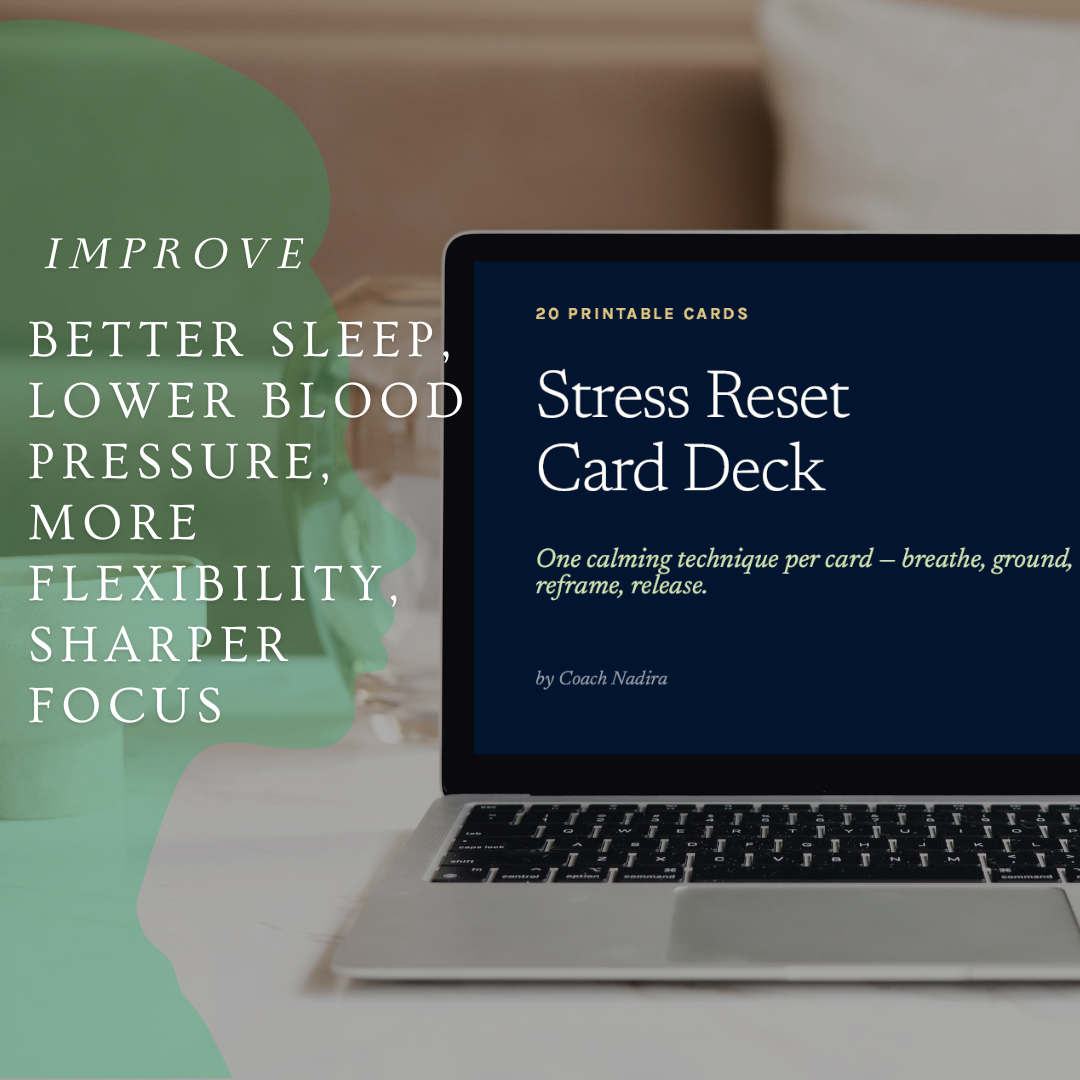
Stress Reset Card Deck — $15
20 cards across all four categories above — Breathe, Ground, Reframe, Release — one clear instruction per card for the moment stress hits.
See the Card DeckTry it right now: the physiological sigh
- 1. Inhale through your nose until your lungs feel mostly full.
- 2. Without exhaling, take a second, shorter inhale on top of the first — this is what makes it a "double inhale."
- 3. Exhale slowly through your mouth for as long as feels comfortable. Repeat once or twice.
"You don't need to fix your whole nervous system in one afternoon. You need one thing you can do in the next ten seconds."
— Coach Nadira
Sources
- Stanford Medicine (2023), "Cyclic sighing can help breathe away anxiety" — the 111-person, one-month breathing study
- Balban et al. (2023), Cell Reports Medicine, "Brief structured respiration practices enhance mood and reduce physiological arousal" — full study results
- Buhle et al. (2014), Cerebral Cortex, meta-analysis of 48 neuroimaging studies on cognitive reappraisal — the reframing evidence
Frequently Asked Questions
What is the fastest way to calm down in the moment?
Is breathing really more effective than meditation for stress?
Do grounding techniques like 5-4-3-2-1 actually work?
Is the Stress Reset Card Deck a replacement for therapy?
Ready for a tool, not just a tip?
$15 · 20 cards · one clear action, whenever you need it.
See the Card Deck