Why Habit Trackers Work (When Willpower Alone Doesn't)
"Just be more disciplined" is not a strategy — it's a hope. Here's what the actual research says about why writing a habit down changes whether you keep it, plus the honest myth-busting on that "66 days" number you've probably heard.
By Coach Nadira · Habits · 8 min read
Photo by Ann H via Pexels
You've probably heard that it takes 66 days to build a habit. It's repeated so often it's practically wellness folklore. It's also, in the way most people use it, a myth — or at least a serious oversimplification of a much more interesting study. Let's look at what the actual research says about habits, tracking, and why a simple checklist can outperform sheer willpower.
Where the "66 days" number actually comes from
The number traces back to a 2010 study by Phillippa Lally and colleagues at University College London. Ninety-six volunteers picked a new habit to build and reported daily on how automatic it felt. Eighty-two provided enough data to analyze, but only 39 of them showed a clean enough pattern to fit the researchers' curve-fitting model at all.
For that subset of 39 people, the median time to plateau was 66 days. But the actual range was 18 to 254 days — a fourteen-fold difference — and it varied by behavior. Exercise habits took a median of 91 days; eating habits, 65; drinking more water, 59. The researchers were also measuring "automaticity," meaning how effortless a behavior felt, not habit formation in the strict clinical sense. It's a real and interesting finding — it just isn't the tidy universal countdown timer it gets turned into.
The honest bottom line
There's no single number that tells you when a habit will "stick." It depends on the behavior, the person, and a lot of variables no study has fully mapped. What's far better supported is how you build one — and that's where tracking comes in.
What actually is well-supported: tracking your progress
A 2016 meta-analysis by Benjamin Harkin and colleagues pooled 138 studies covering nearly 20,000 participants across health, academic, and other personal goals. The finding was clear and consistent: monitoring your progress toward a goal produces a real, medium-sized improvement in your odds of actually reaching it — and the effect got stronger the more frequently people checked in.
- Writing it down beats thinking about it. Physically recording progress — on paper, in an app, anywhere outside your head — consistently outperformed simply being aware of how you were doing.
- Visible beats private. Progress that was shared or made visible to someone (or something) else showed a bigger effect than tracking kept entirely to yourself.
- Track the behavior, not just the outcome. Harkin's research suggests that if your goal is a behavior change, monitor the behavior itself (did I do the thing today) rather than only a downstream outcome, which moves for lots of reasons besides your effort.
There's also a well-documented pattern called "the ostrich problem": people are most likely to avoid checking their own progress exactly when they suspect it's gone badly — which is precisely the moment checking in would help most. A simple, low-friction tracker lowers the bar enough that checking in stays easy even on the days you'd rather not.
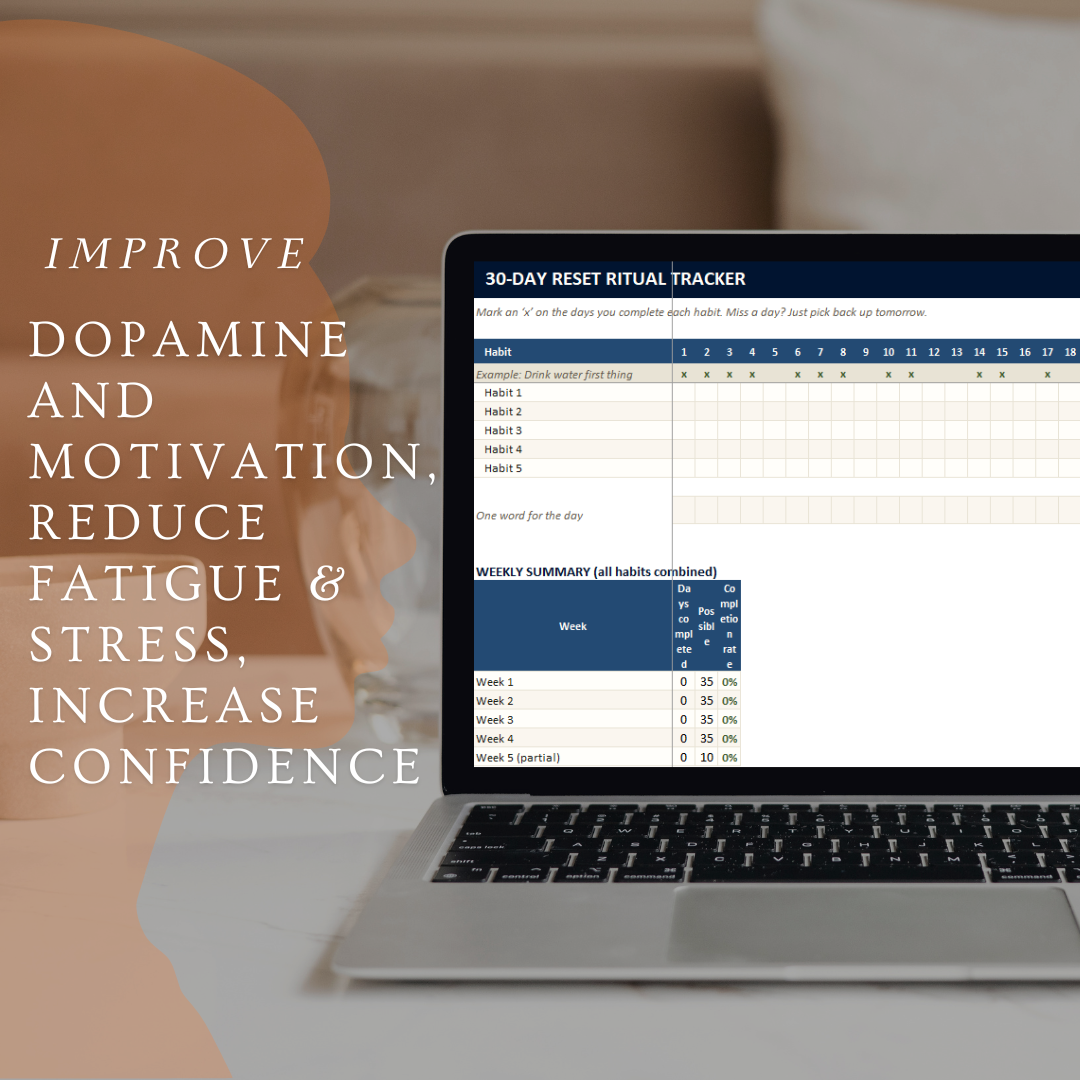
Reset Ritual Habit Tracker — $19
A simple, physical way to log the behaviors that actually matter to you — built around exactly the "write it down, make it visible" pattern the research supports.
See the Habit TrackerOne honest caveat: tracking isn't always neutral
We'd be doing you a disservice if we only told you the upside. Health and eating-disorder researchers, including groups like the National Alliance for Eating Disorders, have raised real concerns that food- and fitness-tracking apps can, for some people, slide from helpful awareness into obsessive checking, anxiety, or disordered patterns around eating and exercise. If tracking something ever starts to feel like a source of dread instead of a small, satisfying checkmark, that's worth paying attention to — the fix is usually to simplify what you're tracking, or step back for a while, not to push harder through it.
Three ways to make a tracker actually work for you
- 1. Track the behavior, not the perfection. A simple checkmark for "did the thing" beats a detailed log you'll abandon by week two.
- 2. Put it somewhere you'll actually see it. Visibility is one of the two biggest levers in the research — a tracker buried in an app you never open won't help much.
- 3. Expect it to take longer than you think, and don't quit at day 21. Given the real range in the research (18 to 254 days), a slow start doesn't mean it isn't working.
"Motivation gets you started. A simple checkmark you can see every day is what actually gets you to day sixty."
— Coach Nadira
Sources
- Lally et al. (2010), European Journal of Social Psychology, "How are habits formed: Modelling habit formation in the real world" — the original 66-day study and its true range
- The Behavioral Scientist, "How Long Does It Take to Form a Habit? What Lally et al. Actually Found" — plain-language breakdown of the study's real methodology and limits
- Harkin et al. (2016) meta-analysis summary, American Psychological Association — 138 studies, ~20,000 participants, on monitoring goal progress
- National Alliance for Eating Disorders, "From Tracking to Trapped: When Health Apps Fuel Disordered Eating" — the honest caveat on over-tracking
Frequently Asked Questions
Does it really take 66 days to build a habit?
Does tracking your habits actually help you keep them?
What's the best way to track a habit?
Can tracking a habit backfire?
Ready to make progress visible?
$19 · a simple, printable way to see the pattern you're building.
See the Habit Tracker